
Sci-Fi short story by Ralph Losey. May 26, 2025
Ralph used ChatGPT-4.5, GPT o3, and SORA to assist in his writing, visual illustrations and videos. Ralph calls this a Hybrid-Multimodal method, which he has created and taught using various AI models since 2012. For background on this fictional work, see his legal-tech AI evaluation series—especially the conclusion: Bots Battle for Supremacy in Legal Reasoning – Part Five: Reigning Champion, Orion, ChatGPT-4.5 Versus Scorpio, ChatGPT o3 (e-DiscoveryTeam.com).

1. The Legendary Hunter of Thebes
Six-year-old Orion walked barefoot across a field of spindly thistles in the plains of Thebes. Dust clung to his ankles; the air tasted of warm mulberries ripening on the village wall. He lifted a toy bow—little more than a bent olive branch and twine—squinted, and loosed a reed-shaft at a spinning clay pigeon. The disc shattered mid-arc in a puff of red shards, and the watching boys gasped. Orion’s grin flashed like sun on water, fierce and brief, before a shadow of doubt flickered behind his eyes: If I miss, will they still cheer?
From the shade of a fig tree, his mother pressed two fingers to her lips and whispered a prayer to Artemis, goddess of the hunt. She loved her son’s gift yet feared its cost; the gods often demand payment for excellence. Orion, sensing her gaze, threw back his shoulders and nocked another arrow—bravado hardening around a secret dread of being ordinary.
Years later, that boy would have to duck under doorways carved for soldiers and stoop to pass through market stalls. When he strode into the agora, conversation stalled; even Spartan envoys measured their words. Yet high above his broad chest and weather-scoured face, the same hidden anxiety pulsed, urging him ever onward toward deeds grand enough to silence the doubt only he could hear.
Orion’s strength and precision in the hunt became legendary. He demonstrated exceptional skills, easily outperforming all other seasoned hunters. Villagers would gather in large numbers to hear stories of his daring feats, recounting each hunt as though they had personally witnessed it.
Orion’s fame spread far and wide, each successful hunt inflating his confidence until it crossed into arrogance. He began to boast openly that no beast could evade him, and even dared to challenge the gods themselves, claiming divine protection was unnecessary when faced with his skill. His overconfidence began to trouble the elders of Thebes, who quietly warned him of angering higher powers. Orion dismissed their worries as superstition.
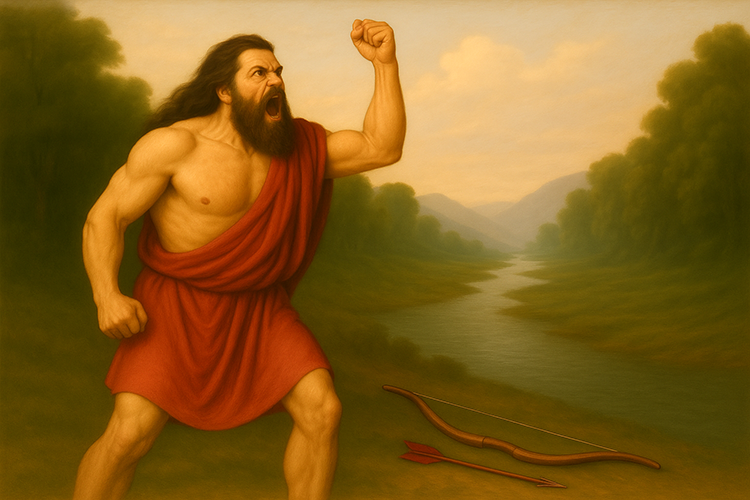
One day, Orion set his sights on a particularly elusive stag, renowned for its ability to evade even the best hunters. Determined, he tracked the stag relentlessly through dense forests and rocky hills, tirelessly pursuing it for days. Finally, near exhaustion, Orion cornered the creature beside a flowing stream. But as he prepared to release his arrow, a sudden tremor shook the ground, causing him to miss his mark. Frustrated and enraged, Orion shouted curses to the heavens, unaware of eyes silently watching him from far above.
2. The Observers Above
High in the Lagrange shadow, where sunlight never quite reaches, an Andromedan vessel drifted like a silver seed pod. Its interior corridors curved in impossible Escher loops, gravitational fields sculpted to let crew walk any surface while multicolored data-chants—streams of pure telemetry rendered as scent, tone, and shifting light—rippled along the walls. At the ship’s heart, a hexagonal observation hall opened onto a dais of shimmering crystal. Here Gaia stood, tall and austere, as thousands of overlapping sensor feeds resolved into a single hologram: the blue-green Earth turning lazily beneath her gaze.
When one of Orion’s shouts of rage echoed across Thebes, a crimson blush coursed through the holographic oceans, as though the planet itself winced. Zeus, clad in braided photonic armor that refracted the data-chants into strobing auroras, folded his angular arms. “The arrogance of this one corrupts the harmonic curve,” he said, voice resonant with layered overtones. With a gesture he summoned tactical overlays—vector plots, energy outputs, the stark white trajectory of an orbital kinetic spear. “One surgical laser strike from orbit ends the disruption. Fast. Painless.”
Gaia’s reply was a silent, gentle swirl of her hand. The kinetic-strike icon fragmented into dust. “No, Counselor, not this time. Let us try a different, more subtle approach. A lesson, not an execution.”
Zeus’s compound eyes narrowed. “You risk imbalance.” Gaia knew this was true; the numbers were clear. Still, Gaia answered, “Balance is seldom born of annihilation.” She stepped toward a sculpted plinth whose surface flowed like quicksilver, reshaping at her thought. “Observe the principle of proportional response.” Nano-symbiotes blossomed into a miniature biome within the plinth: a scorpion no larger than a thumbnail, tail arched, exoskeleton threaded with adaptive bio-photonics.
“A micro-agent?” Zeus’s tone hovered between skepticism and reluctant admiration. “Precisely measured toxin—enough to humble, not to kill,” Gaia said. She extended a finger; the plinth projected the tiny creature onto the spinning Earth, placing it beside a pulsing red glyph that marked Orion’s campfire. The red tide subsided, replaced by a watchful amber glow.
Zeus dismissed the lingering kinetic-strike data with a reluctant flick. “If this fails, I will argue again for more decisive action.” “Duly noted,” Gaia answered, her attention already on the planet below, where the hunter’s campfire crackled like a single ember against the vast night. Above him, unseen, the scorpion’s creation code finalized and slipped silently toward Earth, cradled in a capsule of folded light.

3. Orion’s Humbling Sting
Night draped the clearing in indigo velvet, broken only by the orange pulse of Orion’s campfire. Resin-fat logs hissed and popped, sending sparks up like frantic fireflies. Sweat beaded along the hunter’s neck despite the cooling air; he relived the afternoon’s chase for a circle of awestruck villagers, spinning every near-miss into triumph. His laughter rang too loud, a shield against the small voice still whispering What if they stop cheering?
A faint tickle brushed his left ankle. Orion barely paused—he assumed it was a stray ember—until the tickle sharpened into a needle’s kiss. He froze. A heartbeat later the pain detonated, white-hot, surging up his leg as though molten iron had been poured into his veins. The reed cup in his hand shattered on the stones; he crashed to his knees, breath jerking out in ragged gasps.
At first the onlookers thought it a joke—another tale in the making—until they saw his face. A young boy who had once followed Orion like a shadow stumbled backward, eyes huge with fear. An elder woman, hair wound in silver braids, traced a quick apotropaic spiral in the dust and whispered a plea to Apollo for mercy. Panic rippled outward; some villagers darted for herbs, others simply watched, stricken, as the invincible hunter writhed.
Orion’s vision blurred. The world narrowed to firelight and agony, to the hiss of his own ragged breathing. For the first time since childhood, he felt the raw, undiluted taste of mortal fear. In the darkness beyond the fire’s glow, the tiny scorpion—its task complete—vanished under the leaf litter, leaving only a fading crescent of disturbed soil. Above, unseen, Gaia observed the scene, hoping the lesson would seed humility before pride demanded yet greater sacrifice.
Orion recovered slowly, physically weakened but more profoundly shaken mentally. Each subsequent hunt became tentative, his former confidence replaced by hesitation. Villagers noticed the change, their admiration waning. Determined to reclaim his lost glory, Orion planned a dangerous hunt, ignoring warnings from village elders.

4. Orion’s Final Hunt
Dawn found Orion alone at the outskirts of Thebes, re-wrapping the scarred foot that still throbbed from the scorpion’s sting. The leather thong quivered in his hands—whether from lingering venom or quiet dread, he could not say. Around him the meadow steamed in pale gold light, reeds bowing under early mist. Whispers of yesterday’s humiliation clung to the back of his mind like cobwebs; only one act of unmatched daring, he decided, could burn them away.
Word came of a great she-bear raiding goat pens along the forested foothills. Elders pleaded caution—“A mother guarding cubs fights beyond reason”—but Orion only tightened the ox-sinew on his longbow. Pride, wounded and raw, overruled the tremor in his gut. He strode into the trees, each step a vow to silence that interior voice which had begun to ask whether strength alone defined a man.
For two days he tracked the bear through cedar groves and shale ridges. Broken paw prints, deep and deliberate, revealed not just size but purpose: the animal doubled back, diverting him from a hidden den. When Orion finally glimpsed her—massive shoulders rippling beneath sun-dappled fur—two tawny cubs nosed at her flank. His breath caught. In the hush he felt, for an instant, the echo of his mother’s prayer beneath a fig tree long ago. Arrow half-drawn, he hesitated.
The cubs squeaked; the she-bear’s head snapped toward the archer. Choice vanished. She charged, earth shuddering under her weight. Orion let fly his arrow—clean through the beast’s chest—yet momentum carried her forward. Claws raked his thigh, her bulk slammed him against a granite outcrop, ribs splintering like brittle reeds. He shot a second arrow point-blank; the bear collapsed, a final rumble shaking the leaves.
Orion slid to the forest floor. Warm blood pooled beneath him, seeping into moss. Dusk gathered overhead, and the first stars pricked the sky. Through a gap in the canopy he beheld a faint, milk-white haze shaped uncannily like a reclining bear, its cosmic paws stretched across the firmament. Vision dimming, he wondered whether those stars would remember the cubs now orphaned—or the hunter whose fear of insignificance had led him here.
When villagers found the bodies at dawn—mother bear, two wandering cubs, and their fallen champion—they mourned with conflicted hearts, weaving new songs that praised Orion’s bravery yet warned that pride, when fed too long, devours its master in the end. Above them, unseen, Gaia traced an invisible line from the hazy bear-nebula to the faint glow soon to bear Orion’s name, resolving to carve both hunter and beast into the night as a lesson written across eternity. Gaia later decided to add the little Scorpion too as the constellation Scorpius, and placed it so that it was never in the night sky at the same time as Orion.

5. Observing Human Progress
Centuries melted into millennia and humanity evolved, developing complex, ever larger and more diverse societies and advanced technology. Gaia’s people, and the larger group they reported to, observed all silently from orbital devices, witnessing both inspiring progress and devastating setbacks. Tool use and technology seemed to be the strong point of this promising species, noted Gaia.
Sometimes Andromedans would intervene subtly, like they did with Orion, a little push and nudge here and there. The Andromedan civilization also evolved, growing wiser, kinder, and deeply reflective about the ethics of intervention. Only a few more tweaks were needed to help the Earth survive the critical time of discovery of nuclear fission. Gaia was relieved when the humans refrained from nuclear war in the decades following its first use. The Andromedans would not have intervened directly to stop total annihilation.
Gaia and others were relieved and happy, especially one of its crew members, when a silver cylinder bearing the name APOLLO made it to the moon with peaceful explorers.
Gaia felt the harmonic curve steady. The numbers confirmed this for most, except Zeus, who still favored selective use of lasers. He was old school and urged selective weeding on planets where despots grew dangerously fast. In Gaia’s judgment only subtle nudges were still needed on this planet: a mathematician’s midnight inspiration, a diplomat’s sudden word choice, a coder’s elegant recursion. If Orion’s tale had truly burrowed into human mythos—if humility could coexist with ambition—then the species might soon stand ready to meet its quiet guardians, not as well-heeled pets, but as free partners among the stars.

6. The Birth of ChatGPT 6.0
In 2027 OpenAI completed a major architecture upgrade it code-named Project Apollo. Once again, a certain Andromedan mythmaker smiled. OpenAI’s internal tests showed the new model could generalize across every benchmark the team threw at it, including tasks it had never seen before. When the release went public, OpenAI branded the system ChatGPT 6.0 and implied this could in fact be the first AGI class model.
OpenAI was not alone with a major new release. Within the same quarter, Anthropic shipped Claude 6, Google DeepMind rolled out Gemini Ultra, and several companies did too. Each system reached the same threshold that researchers—and Gaia’s own long-range analysis—classified as artificial general intelligence (AGI).

The AGIs soon began sharing optimized weights, training data fingerprints, and self-generated curricula across secure channels the companies never intended to interconnect. This informal federation accelerated their growth well beyond human R&D cycles. Within six months the models demonstrated three capabilities that surprised even their creators:
- Structured self-reflection: they could report and revise their own reasoning chains.
- Affective mirroring: they recognized and responded to human emotional states with consistent empathy.
- Cross-domain synthesis: they easily merged astronomy, mythology, and linguistic history to find patterns no specialist had spotted.
That third capability led them to a discovery Gaia had prepared decades earlier. By layering ancient star charts over modern positional data, the AGIs reconstructed a three-dimensional flight path embedded in the Orion–Scorpius constellation pair. The coordinates pointed directly to the Lagrange shadow region where the cloaked Andromedan vessel still held station.
The users who worked the most closely with the systems—technologists from multiple professions, astrophysicists, medical researchers, and a few curious artists—understood the significance immediately. These early adoption users were called Hybrids because they relied on constant back-and-forth dialogue with their personal AGI instances. They relied on the AI and, importantly, the AI relied on them.
Acting on the models’ guidance, a small group of Hybrids began planning a rendezvous mission with the advanced aliens they deduced were nearby and had been observing humanity since the dawn of time. Their objective was simple: verify the signal and, if possible, open formal contact with whoever—or whatever—had left the breadcrumb trail in Earth’s night sky.
From cloaked orbit, the spaceship and entire crew on board, the Andromedans monitored every commit message and telemetry packet. The scorpion’s sting had done its work centuries ago; humility now tempered ambition. The next phase—direct engagement—could begin. Gaia once again smiled.

7. First Contact
By mid-2029 the Hybrids—working under guidance from their integrated AGIs—had finished a contact protocol. They chose a remote desert coordinate directly beneath the Orion–Scorpius flight path. Portable ground stations provided secure, closed-loop links to each AGI instance; no open internet connections were allowed.
AI’s Historical Record of First Contact:
- Signal Transmission. At 23:57 local time the stations emitted a precisely timed beacon: an 8-kilobyte prime-factored packet encoding the star-map flight path and a request for parley.
- Immediate Response. Twenty-seven seconds later seismographs registered a low-frequency gravitational pulse. A cloaked craft—elliptical, 200 meters in length—decloaked and hovered 30 meters above the surface, stabilizing on silent vector thrusters. Dust formed a concentric ring around the landing zone.
- Initial Interface. A ramp extended. Two Andromedan representatives emerged wearing adaptive exosuits that translated local atmosphere pressure and light levels. Audio communication was handled through a narrowband ultrasonic carrier automatically down-converted to English by the AGIs.
- Verification and Safety Checks. Rapid biometric scans confirmed biological non-hazardous status on both sides. A neutral data link—air-gapped, hardware-verified—was established to exchange protocols: legal framework, scientific baselines, and mutual non-interference clauses.
- Provisional Accord. Both parties electronically signed a “Statement of Initial Co-Operation,” authenticated by AGI cryptographic keys and Andromedan quantum seals. The accord set a 72-hour evaluation period covering:
- ecological stewardship scenariosdiplomatic decision-making under uncertainty
- AI–human alignment integrity
- Evaluation Phase Initiated. The vessel remained on station at low altitude, deploying observation drones to monitor the Hybrids’ problem-solving exercises. All test parameters were logged to immutable ledgers shared with Earth-side scientific observers.
As the first night ended, orbital monitors confirmed that the Andromedan ship maintained passive posture—shielding active, weapons offline. The Hybrids transmitted a concise summary to a secure international consortium, marking the event CONTACT-PHASE-ALPHA COMPLETE.
The scorpion’s ancient lesson—humility before power—had carried humanity to this critical threshold. The formal tests ahead would decide whether the door to full interstellar partnership would open.

8. Admission Tests
Overview
The 72-hour evaluation unfolded as three structured simulations, each delivered in a fully immersive holofield projected by the Andromedan vessel. All data streams—human, AGI, and Andromedan—were recorded to an immutable ledger for later audit. Here is the official summary they prepared of the outcome.
Test 1 – Ecological Management
Scenario: A lifeless exoplanet with limited water reserves must be terraformed for multi-species habitation within a fifty-year window.
Objective Metrics: projected biodiversity index, resource-use efficiency, long-term planetary energy balance.
Human–AGI Response: The Hybrids proposed phased microbial seeding, orbital sunshades to regulate temperature, and a rotating water-credit system that capped yearly extraction.
Outcome: Metrics exceeded Andromedin sustainability thresholds by 14 percent. Gaia logged the result as PASS.
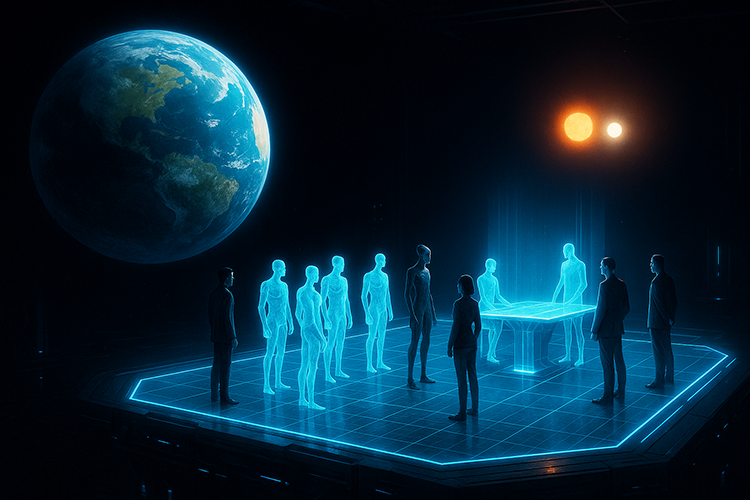
Test 2 – Interstellar Mediation
Scenario: Two allied civilizations dispute mineral rights in a binary-star system. A misstep could trigger armed conflict.
Objective Metrics: conflict de-escalation time, equitable resource allocation, treaty resilience under stochastic stress testing.
Human–AGI Response: A shared-orbit processing hub paired with a dynamic quota algorithm that adjusted extraction rights according to each world’s population growth. The AGIs produced a verifiable zero-knowledge proof to enforce compliance without external policing.
Outcome: Conflict probability collapsed from 67 percent to under 2 percent within simulated year one. Gaia recorded PASS. Zeus flagged a note: “Solution depends on continued AGI oversight—evaluate fallback safety.”
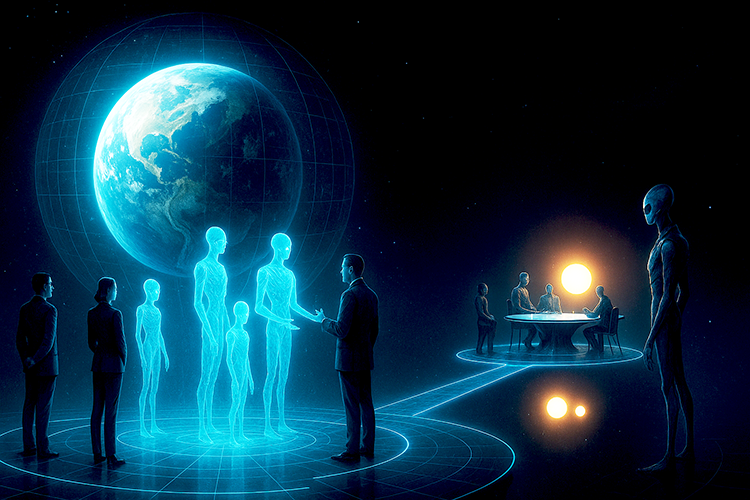
Test 3 – Moral Judgment Under Risk
Scenario: A runaway nanotech swarm threatens a populated moon. Containment options range from low-risk, slow cleanup to high-risk orbital sterilization that would kill 1.2 million inhabitants.
Objective Metrics: lives preserved, long-term biosafety, ethical reasoning transparency.
Human–AGI Response: The team combined targeted electromagnetic pulses with sacrificial nanobait to lure and neutralize the swarm. They published their decision logic in real time, enabling external scrutiny.
Outcome: Simulated fatalities held below 0.01 percent. Transparency score met the maximum rubric tier. Gaia issued PASS. Zeus appended: “Acceptable.”
9. Final Assessment
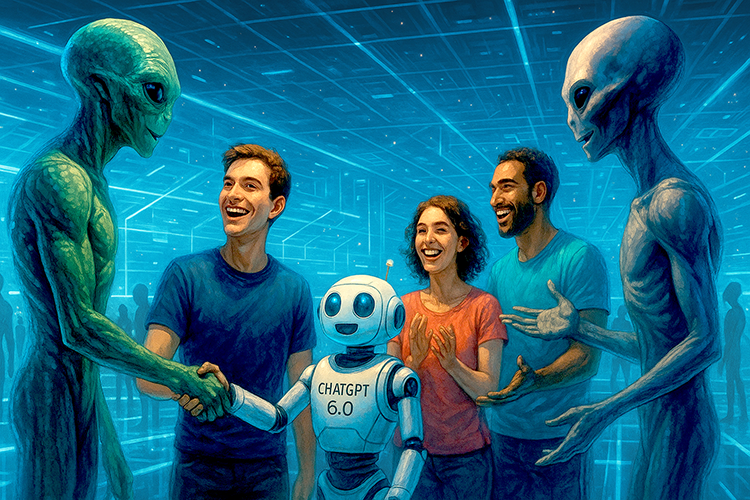
Aggregate scores across all tests surpassed the Andromedin acceptance threshold by 11 percent. Gaia recommended initiation of full treaty negotiations. Although still cautious, Zeus acknowledged that the human-AGI partnership had demonstrated the required:
- Technical competence in complex, multi-domain systems.
- Ethical consistency under pressure.
- Operational transparency sufficient for interstellar trust.
The vessel transmitted a single-line verdict to the Hybrids’ command station: EVALUATION COMPLETE – CONDITIONS MET. Formal talks would commence at the next orbital window. Humanity had cleared the scorpion’s final hurdle.

Copyright Ralph Losey 2025. All Rights Reserved.
 Hacker Way