Why we must use this powerful new speech tool for good before it destroys us—and how a thoughtful minority can still find the path to actual wisdom.
Ralph Losey, August 2026
I. The Glowing Screen and the Battle for the Mind
Late at night, in the quiet of my study, I often look at the screens glowing on my desk. I have been sitting in front of these glowing rectangles since 1980, when personal computers were a brand-new, radical experiment. Back then, a handful of us—hippies, hackers, misfits, and dreamers—saw computers not as cold business calculators, but as “bicycles for the mind.” We believed with a revolutionary fervor that this technology would lift humanity out of the dark ages of ignorance and into an era of unprecedented light. This foundational ethos was explored in my early essay on the Computer Revolution – Hacker Way, where I traced the historical shift from raw calculation to personal empowerment.
But if you look around today, on the horizon of 2026, it is clear that our original vision has collided with a messy reality. We did not achieve sudden collective enlightenment; instead, we built a digital deluge. We are drowning in a relentless, exhausting flood of raw, unorganized electronic information—a post-truth landscape populated by algorithm-driven “alternative facts,” deepfakes, and hyper-targeted digital echo chambers. Our attention spans have fractured, and the temptation to outsource human cognition to machines is stronger than ever. This is the background I addressed in From Information to Knowledge to Wisdom: Can Ai Save the Day? – Part 1, warning of the existential “survival step” we face if we remain stagnant in a superficial information flood.
The core of my philosophy, which I have written about for decades, is the transition From Information to Knowledge to Wisdom: Can Ai Save the Day? – Part 2. I have always argued that raw information alone is superficial, easily manipulated, and deeply entropic. Staying stuck in this superficial deluge threatens the very survival of our democratic institutions and our collective sanity. To survive, we must transition from a culture obsessed with processing speed to one anchored in active, structured knowledge. And the final peak—Wisdom? That is the ultimate, hard-fought battle of our generation. True wisdom, or what the ancient Greeks called *phronesis*, represents knowledge converted to beneficial action for the common good. It is not an automatic evolution, but an active, daily fight for human intellect.
As an active lawyer and computer programmer who has spent forty-five years in the legal trenches and late nights coding, I have watched this struggle unfold first-hand. It is my ideas and predictions that serve as the scaffolding for this essay. While other thinkers and frameworks will be introduced to buttress my points, make no mistake: this is a call to action based on my lived experience. We are standing at a historic crossroads. We have built tools of incredible power, but if we simply use them as cognitive shortcuts, we will destroy our own capacity to think. This article is a guide for the thoughtful minority who refuse to let their minds atrophy.
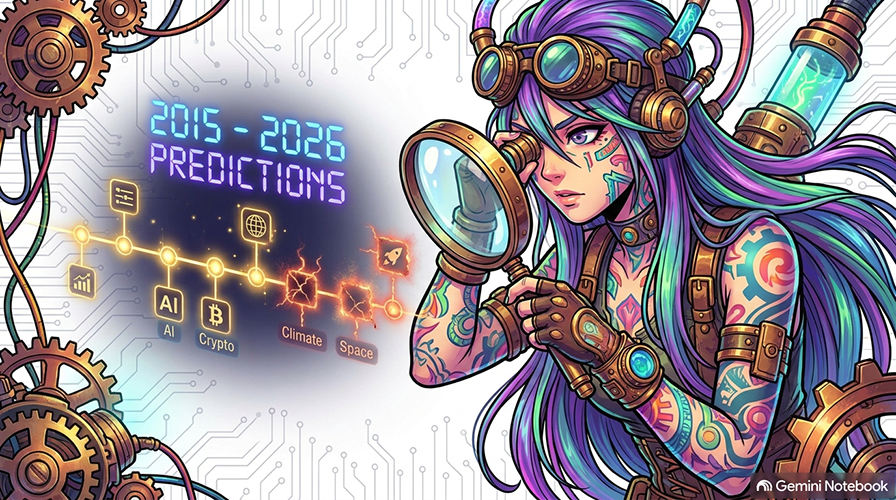
II. Auditing the 2015 Predictions: A Decade Under the Lens
To understand where we are going, we must first look back. In April 2015, I published twelve specific predictions regarding how society would transition from an Information-based world to a Knowledge-based society. I set a highly optimistic timeline of five to twenty years—spanning from 2020 to 2035. This historical audit was detailed in my follow-up piece, Examining the 12 Predictions Made in 2015, where I looked at the technical and sociological forces shaping our trajectory. Looking back from 2026, we can evaluate these forecasts with scientific fairness and intellectual honesty.
A. The Bulls-eyes: Immersive Learning and Expert Networks
Several of my core predictions regarding new technological environments have been spectacularly vindicated. First, I predicted that “insanely great” computer hardware and software would create immersive, multidimensional, 3D educational environments that would take learning to an entirely new level. As early as 2017, this prediction began to bear fruit with tools like Microsoft’s HoloLens in classroom settings, proving that total sensory immersion could dramatically accelerate how humans absorb complex concepts. Today, virtual and mixed-reality learning spaces are no longer a sci-fi novelty, but an established commercial and technical reality.
Second, I forecasted the rapid rise of specialized social media networks and online consulting platforms where real and virtual Subject Matter Experts (SMEs) are featured. I predicted an ecosystem of both free and billed services that would allow anyone to access top-tier knowledge instantly. The explosive growth of curated expert platforms, Q&A spaces like Quora, and targeted digital consulting networks has fully actualized this vision. These spaces have become digital ‘knowledge nests,’ helping individuals escape the superficial clutter of standard search engines.
B. The Delayed Timelines: The Illusion of Automated ‘Truth Screens’
However, some of my predictions remain stubbornly unfulfilled, revealing the hard boundaries of automated systems. In 2015, I predicted that “tireless, non-human AI system administrators” would serve as reliable truth screens, automated fact-checkers, and quality assurance mechanisms. I hoped these AI agents would police our digital networks, filtering out fraud, fake news, and low-quality information to provide a safe haven for human learning.
The 2026 reality is far messier. Instead of acting as objective truth screens, modern Large Language Models (LLMs) have actually *increased* the noise in the infosphere. We are actively fighting an ongoing war against AI hallucinations, fabricated case law, and “stochastic parrots.” As I discussed in Navigating AI Acceleration: Balancing Fear and Judgement, the legal profession has been hit hard by this. Landmark cases like *Park v. Kim* in the Second Circuit, along with databases compiled by legal tech researchers tracking nearly one thousand cases of AI-generated legal errors globally, show that AI cannot be trusted blindly. AI does not screen out lies; in fact, the professional’s *duty to verify* is more critical than ever. Human professionals cannot outsource quality control; we must actively “cross-examine” our AI tools to enforce truth.
C. The Over-Optimistic Societal Curve
My most significant error was not technical, but sociological. I predicted that a full collective transition from an Information-based society to a Knowledge-based society could happen in just 5 to 20 years. I believed that the sheer pain of information overload would naturally force humanity to demand deeper understanding and better processing tools.
While the raw capability of our computer models has scaled exponentially, societal structures have acted as an immense “drag.” We severely underestimated how stubbornly political systems, media algorithms, and corporate incentives would exploit outrage and short attention spans to keep us locked in superficial information bubbles. As a result, the transition has stalled. Society at large has not reached the Knowledge stage; we remain precariously suspended in the entropic clatter of raw, unverified data. This reality highlights the urgent need for a thoughtful minority to lead the way.
III. Redefining the Pyramid: The DIKIW Shift and the ‘Shortcut Trap’
To understand why our collective transition has stalled, we must re-evaluate the classic Data → Information → Knowledge → Wisdom (DIKW) hierarchy. Many critics have pointed out that the traditional pyramid is too passive, assuming that simply amassing information naturally builds knowledge, which eventually crystallizes into wisdom. This flaw was addressed by information theorist Anthony Liew, who proposed inserting “Intelligence” as an active, transitional layer between Knowledge and Wisdom, creating the DIKIW model. This framework was thoroughly analyzed in the modern context in the essay Has AI Stolen Human Intelligence? Redefining the DIKW Hierarchy, proving that the automation of intelligence has changed our relationship with the cognitive pyramid.
Under Liew’s model, Knowledge represents the internalized cognitive understanding of information (answering the *know-what*, *know-how*, and *know-why*), while Intelligence is the active *ability* to apply that knowledge, recognize patterns, reason logically, and solve complex problems. In our current era of Generative AI, Large Language Models have successfully conquered and automated this “Intelligence” layer. Because raw intelligence is a fundamental, mathematical property of matter, it can be compressed into silicon. AI is incredibly skilled at statistical pattern recognition and logical deduction. It has commoditized raw intellectual labor, performing high-velocity reasoning tasks that used to require years of human training.
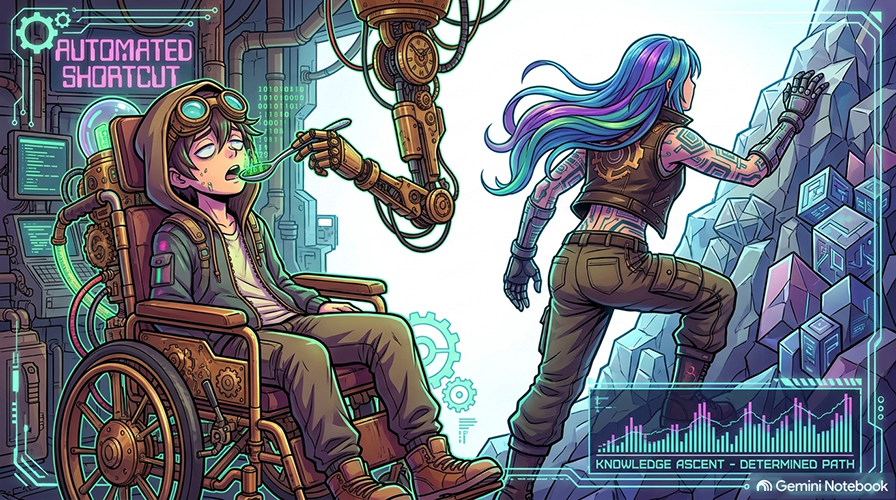
But this technical triumph has created a dangerous **”shortcut trap.”** Because AI can generate highly intelligent-sounding text instantly, humans are increasingly tempted to delegate the actual *process of thinking* to these machines. We are outsourcing our cognitive processing to automated tools, bypassing the vital intermediate step of building our own knowledge. As explored in The Human Edge: How AI Can Assist But Never Replace, this over-reliance acts as an intellectual “wheelchair.” If we stop doing the heavy lifting of active thinking, our own cognitive muscles will inevitably atrophy.
The cost of this shortcut was laid bare in a groundbreaking 2024 Wharton School study of math students. The research compared three distinct groups: students with unlimited AI access, students who had an AI “tutor” that only provided gradual hints, and a control group with no AI access. While the unlimited AI group performed exceptionally well during practice sessions, the results flipped when the AI was removed for a subsequent exam. The unlimited AI group performed **17% worse** than the control group that had never used the technology. By utilizing AI as a shortcut, the students bypassed the “desirable difficulties”—the cognitive friction, effort, and trial-and-error—necessary for deep learning, conceptual retention, and mental growth. If we cheat the climb, we fail to build the mental structures required to understand the world.
IV. Artificial Smarts vs. Actual Intelligence: The Epistemological Wall
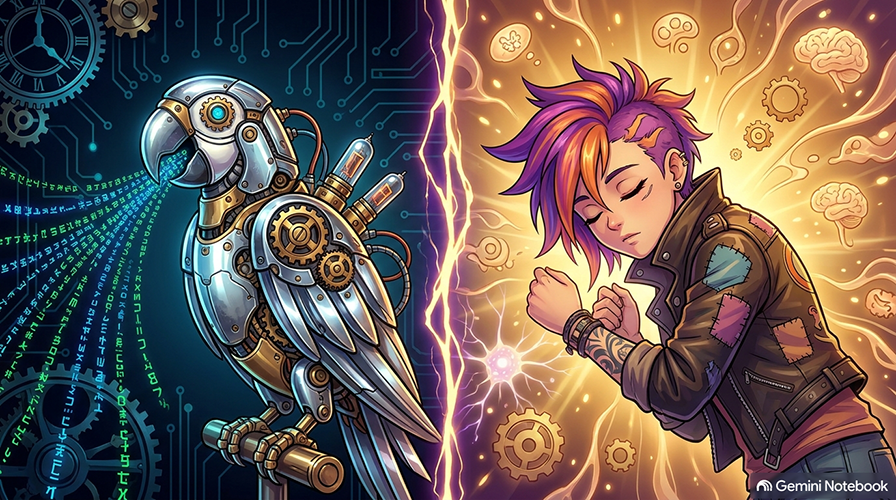
We must therefore draw a sharp linguistic and ontological line in the sand between **Artificial Intelligence (AI)** and **Actual Intelligence (AcI)**—natural human cognition. This distinction is vital to understand what machines can and cannot do, as detailed in my writing on What is the Difference Between Human Intelligence and Machine Intelligence?. AI is a highly advanced, statistics-based tool. It is a brilliant, photographic “stochastic parrot” that takes vast mountains of existing human text and statistically predicts the most probable next word or pattern. It acts as a high-speed “mental kaleidoscope,” endlessly recombining historical data into new shapes, but possessing absolutely no inner life, self-awareness, or genuine understanding.
| Artificial Intelligence (AI) | Actual Intelligence (AcI) |
| • One-dimensional thinking helper | • Multidimensional conscious being |
| • Disconnected statistical abstractions and predictive word-mapping | • Grounded in physical space-time experience and biological body |
| • Combinatorial ‘mental kaleidoscope’ recombining prior data | • Capable of paradigm-shifting, creative sparks and innovation |
| • Simulation of empathy and wisdom without genuine feelings | • Lived, somatic experiences: sleep, dreams, mortality, and gut intuition |
Actual Intelligence, by contrast, is deeply biological, somatic, and multidimensional. True human consciousness and the capacity for wisdom cannot exist in a digital vacuum; they are anchored in a physical, biological body. Human cognition is deeply shaped by interoceptive feedback, biological sensations, and the physical resonance of emotions and gut intuitions that transcend mathematical logic. Furthermore, our minds rely on complex biological processes: the restorative power of deep sleep, the symbolic, creative processing of our dreams, and a profound, visceral awareness of our own mortality.
An algorithm cannot sleep, it cannot dream, and it has no concept of its own death. As Steve Jobs famously observed in his 2005 Stanford commencement address, remembering that you are going to die is the single best tool for avoiding the cognitive traps of pride, fear, and dogma, leaving only what is truly important. AI can beautifully simulate the language of wisdom, repeating ancient moral precepts with flawless syntax, but because it lacks physical presence, moral agency, and biological consciousness, it cannot *be* wise. It operates on statistical abstractions entirely disconnected from physical reality.
V. The Metaphor of the Microcosm: Negentropy in Cybersecurity
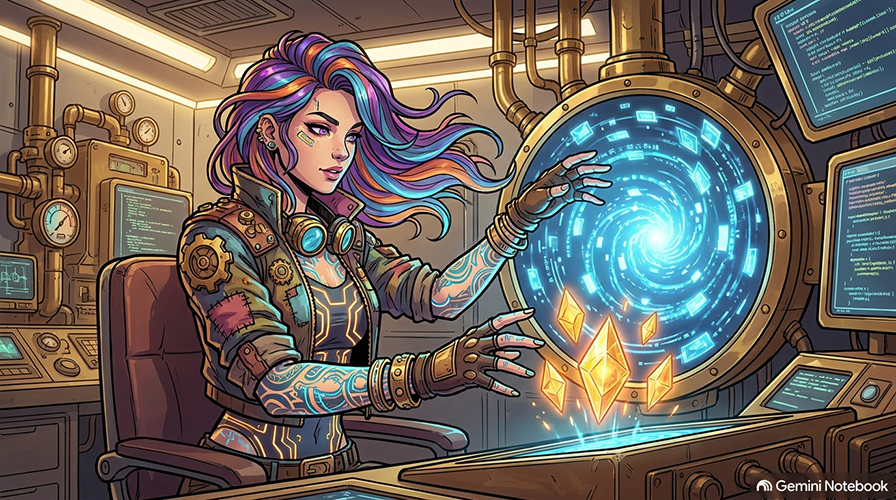
To make these lofty epistemological principles tangible, we can examine a recursive, self-similar microcosm within the high-stakes world of cybersecurity and digital defense. In physics, the Second Law of Thermodynamics dictates that closed systems naturally drift toward disorder, decay, and entropy. Claude Shannon’s foundational Information Theory mathematically aligned entropy with noise, randomness, and uncertainty in communication channels.
Humans, augmented by technology, act as a highly specialized negentropic force—an organizing power that extracts meaning, structure, and order out of chaotic, unstructured data. The high-stress environment of a Security Operations Center (SOC) defending an enterprise network is the ultimate, recursive proof of the I → K → W progression:
1. From Information to Knowledge: The Threat-Hunting Filter
On any given day, an enterprise network generates trillions of raw, unstructured log events, packet captures, and firewall telemetry points. This is a state of complete, entropic noise. Left alone, no human team could ever parse this deluge to find an active intrusion.
By utilizing a hybrid, multimodal defensive stack—combining behavioral machine learning algorithms, heuristic intrusion detection systems, and modern Generative AI threat-analysis tools—we filter out 99.999% of the irrelevant background noise. This collaborative automation reduces trillions of chaotic, raw data points down to a structured, prioritized queue of tens of thousands of verified security alerts and anomaly indicators. This step represents the hard-fought transition from raw, entropic Information to structured, verified Knowledge of our system’s threat landscape.
2. From Knowledge to Wisdom: Strategic Incident Response
But tens of thousands of security alerts are still an overwhelming mountain of cognitive noise to a human incident responder. Cognitive science proves that the human brain can only hold seven items, plus or minus two, in active working memory at any one time. If a security team tries to chase every alert, they will succumb to alert fatigue and miss the breach entirely.
This is where the senior threat hunter must perform the ultimate cognitive refinement. Relying on years of tactical experience, biological gut intuition, and lateral reasoning, they must winnow those tens of thousands of alerts down to the five to nine critical indicators of compromise (IoCs)—the exact, devastating “smoking gun” exploit strings that reveal the attacker’s true entry point, intent, and lateral movement. Deciding how to contain the threat, isolate compromised systems, and ethically protect user data is the decisive step from Knowledge to Wisdom.
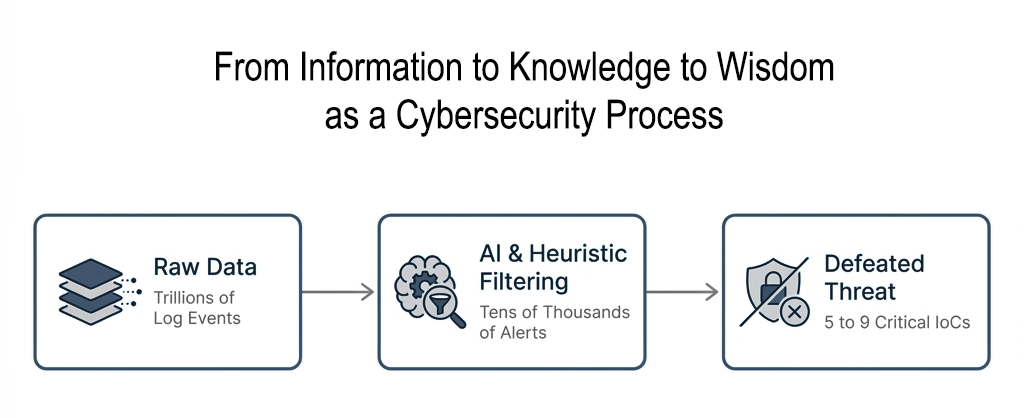
This operational loop proves that fully autonomous AI agents cannot secure our networks alone. In fact, a landmark Stanford-Carnegie study on the “Jagged Technological Frontier” confirmed that fully autonomous AI systems routinely fail when facing complex, multi-stage, real-world tasks. However, the empirical data proved that hybrid human-AI teams outperformed fully autonomous systems by 68.7%. The future of digital defense is not automated displacement; it is a hybrid, synergistic partnership.
VI. The Infosphere: Floridi’s Systemic Shield
As we construct this collaborative, hybrid future, we need a robust philosophical and ethical framework to govern our technology. Yale Professor Luciano Floridi provides this shield through his Philosophy of Information, a model I analyzed in the context of legal technology. Floridi reframes reality not as a collection of physical objects, but as a fundamentally informational environment—the **infosphere**. In this view, biological humans, digital devices, and AI agents are all interconnected informational organisms (“inforgs”) sharing a single, delicate informational ecosystem.
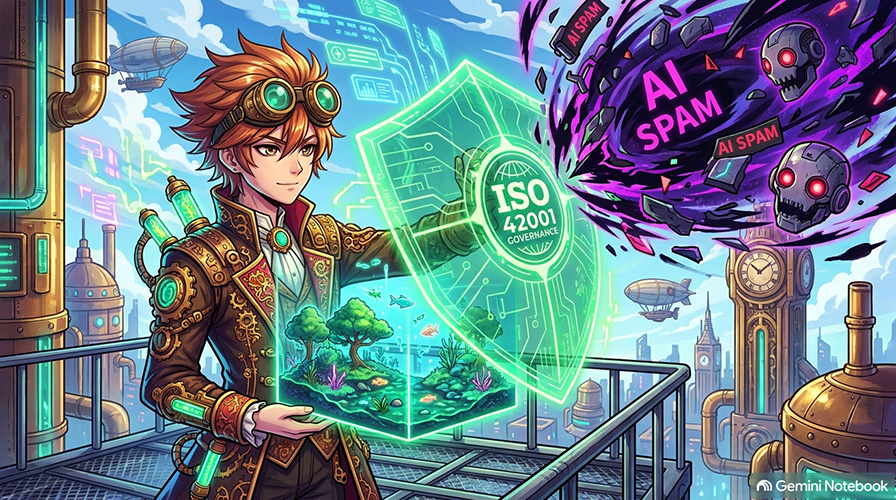
Within the infosphere, our traditional anthropocentric ethics must expand into a systemic, ecological information ethics. Just as physical ecology demands stewardship of our forests and oceans, information ethics demands the stewardship of our digital environment. Systemic wisdom requires that we protect the integrity of the infosphere against the pollution of automated misinformation, AI-generated junk text, and malicious manipulations. We must treat the infosphere with the same reverence we treat our biological ecosystems.
To achieve this, we must build a secure, governed partnership with our machines. Our AI tools must serve as the “Ark” we construct to navigate and survive the digital deluge. This requires proactive, technical governance, including the implementation of international standards like **ISO/IEC 42001**, ensuring that our agentic systems remain auditable, accountable, and permanently aligned with the core parameters of human flourishing. We must guide the machine; we must never let it guide us.
VII. Conclusion: Practical Wisdom and the Great Silence
We began this journey by looking at the quiet tyranny of the screen—the relentless, exhausting flood of digital noise that threatens to drown out our capacity for deep thought. Throughout this essay, we have explored how to fight back. We have audited a decade of tech predictions, analyzed the cognitive dangers of the AI shortcut trap, established the biological wall of Actual Intelligence, and traced the cybersecurity threat-hunting microcosm—the high-stakes journey of winnowing trillions of raw network events down to the handful of critical indicators of compromise that protect our digital frontier. This article has delivered on its opening promise: to provide a realistic, hard-edged roadmap for keeping our minds sharp in an artificial age.
True human wisdom is not a static database, a cold academic dogma, or a set of memorized facts. It is what Aristotle termed *phronesis*—practical, action-oriented wisdom that grasps the ethical truth in any given context and converts knowledge into beneficial action for the common good. Throughout recorded history, this state of being has never been a mass commodity; it has always been a rare peak climbed by only a small, dedicated minority. Today, our screens are louder than ever, and our public leaders are dangerously far from wise. But I hold out a defiant, realistic hope: by utilizing this powerful new AI speech tool with sharp intention and human verification, we can empower a larger, thoughtful minority than ever before to make that climb.
This non-dogmatic path to self-discovery is the founding principle of the School of Wisdom®. As the School’s historical lineage—from Count Hermann Keyserling to Carl Jung—has long taught, wisdom is a strictly personal, experiential transformation of being that can never be programmed, memorized, or outsourced to a machine. Steve Wozniak championed a “laughing life” focused on humor, individual creativity, and light-hearted joy. Steve Jobs implored us to follow our hearts and intuition, reminding us that “everything else is secondary.”
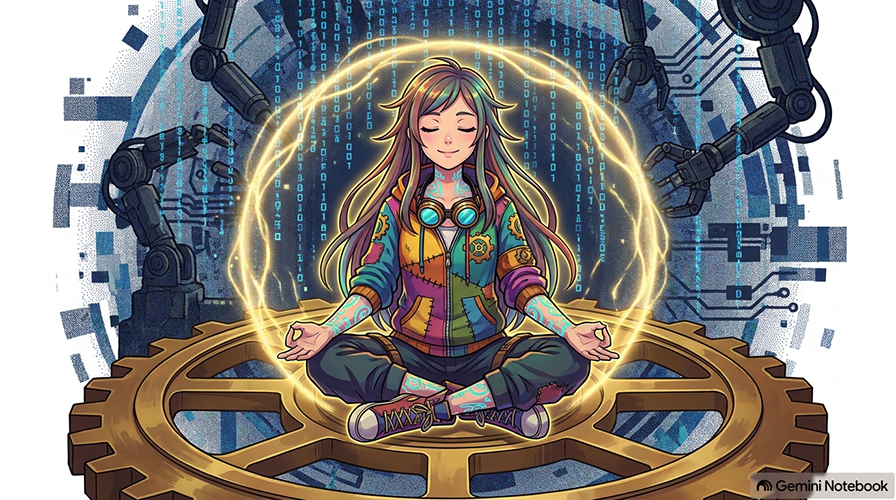
In our hyper-accelerated digital age, we must defend this human core with fierce intention. While our artificial machines are characterized by a relentless, statistical storm of algorithmic output and linguistic noise, the human mind possesses a quiet, sacred, and ineffable superpower: the capacity to halt the inner monologue and rest in **profound, deep inner silence at the core of our minds**. As I explore in the guidebook for PrimaSounds, true wisdom is not born from the accumulation of more automated words, but from our ability to enter that silence, listen to our biological intuition, and preserve the unique spark of conscious being that makes us human. The old Delphic command remains unchanged: *Know Thyself*. Turn off the machine, step into the silence, and begin.
Selected Resources and Further Reading
• Ralph Losey on the Original Hacker Ethos: Computer Revolution – Hacker Way
• Tracing the Core Progression: From Information to Knowledge to Wisdom: Can Ai Save the Day? – Part 1
• Understanding the Path to Wisdom: From Information to Knowledge to Wisdom: Can Ai Save the Day? – Part 2
• Auditing the 2015 Forecasts: Examining the 12 Predictions Made in 2015
• Legal Technology and Information Ethics: What Information Theory Tells Us About e-Discovery
• Cognitive Science and AI: Has AI Stolen Human Intelligence? Redefining the DIKW Hierarchy
• The Humorous Path to Wisdom: School of Wisdom® – Think Universal, Act Global
• Acoustic Meditation and Inner Silence: PrimaSounds – Meditation Music and Guide
• Contemporary Oracular Reflection: Pythia’s Wisdom Reborn as AI
Ralph Losey Copyright 2026 — All Rights Reserved
 Hacker Way